Casinos That Accept E-cheques in the UK
 Available in GB
A payment method listed on a general site page may not be available to every account, so confirm the option and its details in the casino cashier.

Table of Contents
- How to Assess E-cheque Availability at UK Online Casinos
- Checking Whether E-cheque Is Available for UK Players in 2026
- E-cheque Deposits and Withdrawals: What Must Be Confirmed
- Comparing E-cheque Casino Options Without an Unsupported Ranking
- E-cheque Casinos in the Context of Common UK Payment Methods
- Deposit Thresholds and Account-Level Payment Controls
- Payment Ownership and Fraud-Prevention Checks
- Confirming Payment Compatibility Before Depositing
- Withdrawal Timing and Verification
- New Casino Payment Claims and First-Deposit Checks
How to Assess E-cheque Availability at UK Online Casinos
A claim that an online casino accepts e-cheques needs more support than a payment logo or a general statement about banking options. The key distinction is between a method being mentioned somewhere on a site and being presented as an available option for a casino account. Those are not equivalent forms of evidence.
A general payments page may describe methods supported across a company’s services, or list options that are not available to every customer. It may also be incomplete or out of date. A payment method named there is therefore an indication to investigate, not proof that it can be used at a particular casino. This applies to claims about e-cheque casino sites in the UK as much as to claims about any other payment method.
The cashier is more directly relevant because it displays the transaction options associated with the account. Even so, a label alone does not establish every detail of acceptance. The displayed method must be identifiable as an e-cheque, rather than a similarly described bank or cheque service, and its availability must relate to the casino account in question. A result based only on a corporate payment page, an old review or an unexplained logo should not be elevated into a definite claim.
When looking for UK casinos that accept eCheques, check each operator’s payment options directly, as availability can vary. The payout details below offer one practical point of reference.
Payout speed: 1-3 business days Jetsetspins has a stated payout speed of 1–3 business days. Check directly whether eCheques are currently available as a payment option.
Payout speed: 1-3 business days WinBeast has a stated payout speed of 1–3 business days. Check directly whether eCheques are currently available as a payment option.
Payout speed: 1-3 business days NightLuck has a stated payout speed of 1–3 business days. Check directly whether eCheques are currently available as a payment option.
Payout speed: 1-3 business days x3bet has a stated payout speed of 1–3 business days. Check directly whether eCheques are currently available as a payment option.
Payout speed: 1-3 business days Zombillion has a stated payout speed of 1–3 business days. Check directly whether eCheques are currently available as a payment option.
Payout speed: 1-3 business days BeOnBet has a stated payout speed of 1–3 business days. Check directly whether eCheques are currently available as a payment option.
Payout speed: 1-3 business days SlotoSport has a stated payout speed of 1–3 business days. Check directly whether eCheques are currently available as a payment option.
Payout speed: 1-3 business days Chanze has a stated payout speed of 1–3 business days. Check directly whether eCheques are currently available as a payment option.
Payout speed: 1-3 business days SpinFormula has a stated payout speed of 1–3 business days. Check directly whether eCheques are currently available as a payment option.
Payout speed: 1-3 business days EvoSpin has a stated payout speed of 1–3 business days. Check directly whether eCheques are currently available as a payment option.
What counts as meaningful evidence?
Evidence can be assessed in layers. At the weakest level is a third-party page that includes “e-cheque” in a list without explaining where the information came from. A specialist review may be useful as a lead, but its payment information can become outdated, and it may not reflect the options currently presented to casino customers. A casino’s own general information page is more closely connected to the operator, but it still does not show that the method is enabled in the cashier.
A stronger indication is an operator’s current, specific statement that identifies e-cheques as a casino payment option. Stronger still is the method appearing as a selectable option in the casino cashier. The distinction matters because a payment route may be described in broad terms yet not be offered for a particular account or transaction. Where a claim is not supported by direct, specific evidence, its status should remain uncertain rather than being described as confirmed acceptance.
This standard also applies to phrases such as “e-cheque deposits accepted”. The wording may sound precise, but it does not by itself establish that the method is available to UK customers, or that the casino’s cashier offers it. Likewise, a page that refers to electronic banking or cheque processing does not necessarily mean that the casino accepts e-cheques. The payment method needs to be named clearly, and the claim needs to refer to the casino service rather than a different product or a broad company-level offering.


Why broad payment lists can mislead
Payment pages often group methods together for convenience. A list may contain familiar card brands, bank-related services and other payment options, but inclusion on that list does not prove that each is available to every account. A specialist review that lists Visa and Mastercard, for instance, is not a substitute for checking the casino’s own cashier: current UK availability and eligibility can depend on the card product and must be established there. This illustrates why a list is useful as an overview but insufficient as conclusive evidence.
Currency statements need similar care. A page may state that GBP is supported, but that does not establish the currency assigned to a particular account. The account currency should be confirmed before the first transaction, since a mismatch can result in conversion. Currency support and payment-method acceptance are separate questions: confirmation of one does not settle the other.
The same care is needed when assessing a mobile e-cheque casino claim. A site working on a mobile device does not demonstrate that an e-cheque option is available through its mobile cashier. Nor does a method appearing in a general mobile-payment description establish that it is offered for casino deposits. The evidence must address both the named payment method and the relevant casino function; a general statement about mobile access cannot fill either gap.
- Check the casino cashier for selectable options
- Look for direct, specific statements from the operator
- Verify the method is enabled for the specific account
- Rely on general payment logos or lists
- Trust third-party reviews as current proof
- Assume a method is available based on corporate pages
Avoiding an unsupported “best” label
Terms such as “best” or “top” imply that identifiable options have been established and compared on relevant criteria. A ranking of the best e-cheque casinos in the UK would require confirmed operators and reliable evidence that their casino services actually accept e-cheques. Without that foundation, ordering sites would give uncertain claims the appearance of verified choices.
A more defensible assessment separates three questions: whether an operator mentions e-cheques, whether the casino cashier presents the method, and whether the claim specifically applies to UK casino customers. A positive answer to the first question alone is not enough to establish the others. Until the evidence supports those distinctions, an operator should not be labelled an e-cheque casino simply because a broad payment list contains the term.
For 2026, the phrase “casinos that accept e-cheques” should therefore be reserved for options supported by direct, casino-specific evidence, rather than inferred from a generic payment page.
Checking Whether E-cheque Is Available for UK Players in 2026
A payment method can be described on a casino’s general information page without being selectable for every account. For a UK player, the relevant question is narrower: does the casino make e-cheque available to this account, in its current location and circumstances, for the intended transaction? A general claim does not settle that question.
Availability should therefore be treated as account-specific and time-sensitive. Payment menus can depend on details such as the country registered to the account or the options enabled for that customer. A page that names e-cheque may describe a service that is unavailable to UK customers, or that is not offered through the account currently being checked. Neither possibility can be resolved by the label alone.


Check the account, not only the public page
A sensible check begins with the casino’s own payment information, but does not end there. The cashier associated with the relevant account is more pertinent than a general list because it shows the options presented in that account’s context. If e-cheque is not displayed there, a broad statement elsewhere should not be treated as confirmation that it can be used.
Where the method is displayed, its presence still needs to be interpreted carefully. The name may refer to a particular payment service or a product with conditions that are not apparent from the short label. The casino’s explanation should identify what the method means, which customers can use it and whether any restrictions apply. If those details are unclear, the existence of a menu entry alone is not a complete basis for relying on it.
The account profile also matters. Information such as the registered country and the customer’s identity should be consistent with the details associated with the payment route. Using account information and a payment route belonging to the same customer reduces the chance that basic ownership details will cause avoidable friction. This does not establish that e-cheque is offered; it is a separate compatibility check once a method is presented as available.
Confirm the UK context directly
A statement that a casino accepts e-cheques may refer to a different market or to customers with different account settings. The wording should be checked for an explicit UK scope rather than assumed to apply to everyone. If the terms do not clarify whether UK customers are included, the claim remains ambiguous.
Remote gambling licensees serving the British market must hold the relevant Gambling Commission licence, and online gambling is legal in the UK at licensed and regulated sites.
The operator’s current UK-facing information should also be read alongside the account cashier. If the two appear inconsistent, the discrepancy is a reason to seek clarification rather than to infer availability from whichever wording is more favourable. A clear answer should identify the method by name and confirm that it is enabled for the relevant UK account. A generic assurance that the casino accepts online payments would not resolve the specific question.
The legal setting provides a further boundary. Remote gambling licensees serving the British market must hold the relevant Gambling Commission licence, and online gambling is legal in the UK at licensed and regulated sites. A licence does not, by itself, demonstrate that a particular payment method is available. It establishes the regulatory context for the operator, not the compatibility of e-cheque with an individual account.
Treat availability as a current condition
Payment arrangements can change, so an old review or saved list may not reflect what is currently offered. Even a recently published description can be too broad if it does not identify the market and account conditions to which it applies. For a search framed around casinos accepting e-cheque in the UK, the useful evidence is not simply a casino name beside a payment label. It is a current, specific indication that the method is available to UK customers in the relevant account.


This distinction also affects how claims about the “best” or “top” e-cheque casinos should be read. A ranking cannot establish that its entries meet the underlying condition. If the method is not confirmed for UK accounts, a comparative label adds no evidence of compatibility. The same caution applies to lists that combine payment methods from several countries or present a casino’s full payment range without showing which options are available to British customers.
When information is incomplete, the conclusion should remain limited. A casino may mention e-cheque, but that is not equivalent to confirming its availability to a particular UK player. Conversely, the absence of a method from a public page does not establish why it is absent or whether the account has access to it. The point is to distinguish what is displayed from what has been confirmed, rather than fill gaps with assumptions.
For anyone assessing online casinos that accept e-cheque in the UK, the practical test is therefore specific: the current account should show the method, the casino’s terms should explain its UK eligibility, and any uncertainty should be resolved through a clear response from the operator before the method is relied upon. Without that account-level confirmation, e-cheque availability remains unestablished for that transaction.
E-cheque Deposits and Withdrawals: What Must Be Confirmed
A payment method that can be used to fund a casino account is not automatically available for cashing out. Deposit and withdrawal functions are separate parts of a payment arrangement, and a claim about one does not establish the other. This distinction matters when assessing e-cheque casino sites in the UK: an e-cheque deposit option, even if shown, would not by itself confirm that winnings could be returned through the same route.
An e-cheque deposit option does not by itself confirm that winnings can be returned through the same route, as deposit and withdrawal functions are separate.
The cashier needs to identify the function offered for the specific payment method. A deposit option concerns money moving into the gambling account; a withdrawal option concerns money moving out, subject to the casino’s payment rules and any applicable checks. Where a method is described only as a way to add funds, its withdrawal status remains unresolved. Likewise, the absence of a named withdrawal route should not be interpreted as proof that another route will be available.
This is particularly important for searches for casino sites that accept e-cheque deposits in the UK. The wording may suggest that deposit acceptance is the main criterion, but it leaves a practical question unanswered: how would a withdrawal be handled? Before relying on an e-cheque for a transaction, the relevant terms need to make clear whether it is deposit-only, whether it can receive withdrawals, or whether a different payment route may be used. No e-cheque function should be assumed from the method’s name alone.
UK anti-money laundering rules generally require payouts to be returned to the original payment source. That requirement can shape the available withdrawal route, but it does not establish that every payment method supports both directions. If a casino accepts a method for deposits, the payment source and the casino’s rules still determine whether funds can be returned through it. A different route may involve additional checks or may not be offered. The specific treatment of e-cheques therefore needs confirmation rather than inference.

Deposits and payouts follow different processes
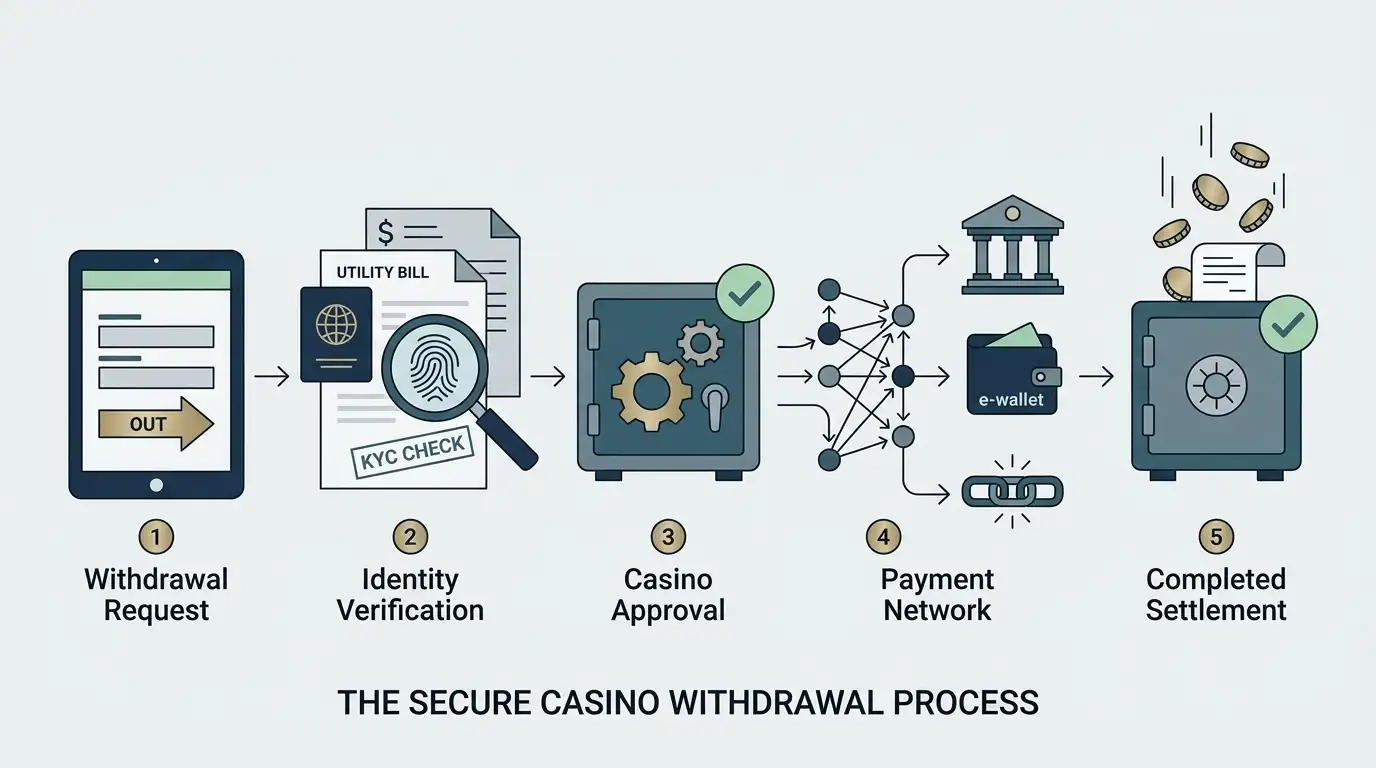
A deposit may appear in an account before a withdrawal is completed because the two transactions do not necessarily involve the same processing stages. A deposit concerns funding the casino balance. A withdrawal can require the casino to review the request, confirm account details and complete any outstanding verification before releasing funds. The eventual delivery time may also depend on the payment route used to send the payout.
A specialist casino-payment review notes that withdrawal processing includes the operator’s internal approval and may take longer for first withdrawals while verification is completed. This is a general explanation of why a payout can take longer than an initial deposit, not a timing promise for any particular casino or payment method. It also does not establish that e-cheque withdrawals are available. Any stated processing estimate would need to be checked against the casino’s current terms and the status of the account.
The difference between a deposit and a payout should also be kept distinct from the time taken for a payment provider or bank to complete its part of a transfer. A casino may have approved a withdrawal before the funds have arrived, while an account may still be awaiting approval before a payout is sent. Without details for the specific transaction, these stages cannot be collapsed into a single expected timeframe.
What a casino’s terms need to clarify
For an e-cheque route, the key issue is not simply whether the method is named, but what the casino permits it to do. The terms or cashier should clarify whether it is available for deposits, withdrawals, or both; whether withdrawals must return to the original source; and what happens if that source cannot receive a payout. These points should be explicit enough to distinguish a supported route from an assumption based on the deposit process.
Payment source returns
UK anti-money laundering rules generally require payouts to be returned to the original payment source to maintain a clear link between deposited funds and return payments.
A casino’s payment rules may also specify that withdrawal requests are subject to account checks. Such checks can affect when a payout is approved, particularly if verification has not been completed. That possibility should not be confused with a payment method being unavailable, nor should a method’s availability be treated as confirmation that a withdrawal request will be processed immediately.
Claims about the best e-cheque casino sites are not meaningful unless the underlying deposit and withdrawal functions are established for the relevant UK account. A site could describe a deposit route without showing that it can return funds through the same method. Conversely, a general statement about payouts does not prove that e-cheques are accepted as a withdrawal route. The practical distinction is between confirmed support for a specific transaction direction and an unverified assumption that the same method works both ways.
Accordingly, an e-cheque should not be treated as a complete payment option until both sides of the transaction are clear. Deposit acceptance and withdrawal availability are separate facts; the payout route and any verification conditions must be assessed independently.
Comparing E-cheque Casino Options Without an Unsupported Ranking
A meaningful comparison of casinos said to accept e-cheques would need to rest on confirmed transaction details, not a payment logo or a general description. The method would have to be identified precisely, and its terms would need to apply to the relevant casino account and transaction. Without that foundation, ranking sites as the best e-cheque casinos would turn an uncertain claim into an apparent recommendation.

The comparison would also need to separate the casino’s own charges from costs imposed elsewhere in the payment chain. A transaction may involve a casino fee, a payment-provider charge, an issuer or bank fee, currency conversion, or a network cost. Which of these applies depends on the route used and the amount transferred. A method described as fee-free by one party may still carry a cost at another point.
Compare the full cost of a transaction
A fair comparison starts with the amount that would actually be deposited or withdrawn and the currency in which the casino account is held. The relevant figure is the total cost of completing that transaction, rather than a single advertised fee. If the account and payment route use different currencies, an exchange-rate spread may affect the final value even when no separate conversion charge is shown.
Charges should be checked at each stage: the casino’s payment terms, the provider’s pricing, and any applicable bank or issuer fees. For a network-based payment, network charges may also matter. These costs are not interchangeable, and a price stated by one provider does not establish that the casino or another intermediary will charge nothing.
A specialist payment review has noted that charges can arise at several points in a transaction. Such a description is a useful checklist, but it is not a substitute for the current terms attached to a particular account and payment route. Fees can depend on the actual transaction, so a comparison based on a generic label may not reflect what a customer would pay.
Comparison Factors
- Compare the total cost, including casino fees, provider charges, and bank costs
- Use the same transaction amount and currency for all compared sites
- Distinguish between fixed fees and currency exchange spreads
- Treat “no fee” claims with caution as other intermediaries may charge
There is no universally cheapest payment method. The lowest-cost route for one transaction may not be the lowest-cost route for another, particularly when currency conversion or network charges are involved. Comparisons therefore need to use the same transaction amount, currency and direction of payment. Otherwise, an apparent price difference may reflect different assumptions rather than a genuine advantage.
Avoid treating rankings as evidence
A list of recommended casinos can imply that each listed site offers the same payment method on comparable terms. That implication is not justified unless the payment route and its costs have been checked consistently across the sites. A casino name beside an e-cheque label does not establish the fee, exchange rate, or other charges that would apply to a specific transaction.
A useful comparison would record the exact method name, the relevant transaction type, the account currency and every disclosed charge. It would also distinguish a fixed fee from a currency spread or a charge determined by the provider or bank. If a cost cannot be established, it should remain unquantified rather than being treated as zero.
The same care applies to claims such as “no fees” or “low-cost”. Those phrases may describe only one part of the payment chain. A provider might not impose a separate charge while a bank, issuer or exchange-rate conversion still affects the amount received. Conversely, a visible flat fee does not by itself show that a route is more expensive than one with a less visible conversion cost.
For a comparison to support a ranking, the underlying figures would need to be current and directly comparable. That means examining the cost of the same transaction under the same currency assumptions, and making clear which party imposes each charge. A ranking that does not show those distinctions risks confusing a payment-method claim with evidence of value.
The practical measure is therefore the complete cost attached to the intended transaction, not the prominence of a method on a casino page or the order in which sites appear in a list. Where the full charge cannot be determined, the comparison should state that limitation rather than assign a “best” position.

E-cheque Casinos in the Context of Common UK Payment Methods
E-cheque claims sit within a payment landscape in which familiar card options provide a clearer point of reference. UK casinos commonly accept debit cards, including Visa and Mastercard. That broad pattern does not establish that every casino accepts either card, or that every card product will work for every account. It does, however, distinguish widely recognised payment labels from an e-cheque claim that may need more explanation before its practical meaning is clear.
The terms should not be treated as interchangeable. A debit-card payment is made through a card network and a linked account; an e-cheque refers to a different form of electronic payment. Similarity in purpose—moving funds to a gambling account—does not show that the methods share processing, eligibility, or payout arrangements. Nor does the presence of Visa or Mastercard on a casino’s payment information provide evidence that an e-cheque option is also supported.
This distinction matters when a casino describes its payment range in broad terms. A general reference to electronic payments, bank-linked payments, or cheque-based services may not identify the specific method available to a UK customer. The wording should be read according to the actual named option rather than interpreted as confirmation of an e-cheque facility. Conversely, the prevalence of debit cards does not make them a substitute for an e-cheque where a particular payment route is required.
The same care applies to comparisons between casinos. A site that lists familiar debit-card brands may be easier to understand as a payment proposition, but that fact alone says nothing about whether it offers e-cheques. An e-cheque casino claim therefore cannot be inferred from a standard payment list or from the general presence of electronic deposits. The method needs to be identified on its own terms.
For UK players, Visa and Mastercard debit cards form part of the common background against which less familiar payment claims can be assessed. They are context, not evidence of equivalence. Keeping those categories separate avoids turning a broad description of casino payments into an unsupported claim about e-cheque availability.

Deposit Thresholds and Account-Level Payment Controls
A deposit threshold is not a property of a casino alone. The minimum shown for one payment route does not establish the minimum for another, and a limit displayed for a card or bank transfer cannot be treated as an e-cheque limit. Any figures need to be tied to the specific payment method and account conditions under which they apply.
One specialist casino-payment review places reported minimum deposits in the £10–£20 range, with the amount depending on the selected method. That is a reported range, not a fixed UK-wide threshold or evidence of an e-cheque minimum. The amount available to a particular customer may also be affected by the casino’s account controls, so a general site summary cannot substitute for the terms presented for the relevant account and transaction.
Maximums require the same distinction. A specialist review notes that deposit caps can apply per transaction, per day or per month, and may differ according to payment method and account status. Those categories describe possible limits; they do not establish a universal cap, nor do they show that an e-cheque route is subject to any particular maximum. A figure published for another method should therefore not be carried across to e-cheques.
Payment thresholds also sit alongside separate financial-limit controls. UK Gambling Commission rules require remote gambling licensees to prompt new customers to set a financial limit before their first deposit. They must also make account-level limit controls accessible. These requirements concern the customer’s gambling account and should not be confused with a payment provider’s transaction ceiling or a casino’s minimum deposit.
For e-cheque deposits, the relevant amount would need to be stated for that method and applicable account conditions. A cashier display or the operator’s applicable payment terms can distinguish a method-specific threshold from a general deposit figure. Where no e-cheque amount is stated, a published minimum or maximum for a different route does not fill the gap. This distinction matters because both the payment method and account status can affect the limits that apply, while financial-limit settings remain an independent control on the account.
Payment Ownership and Fraud-Prevention Checks
For any casino payment, the account holder’s identity and the payment account’s ownership are relevant to fraud prevention. A deposit made through an account belonging to someone else can create questions about who supplied the funds and who is entitled to receive them. Keeping the casino account and payment route in the same person’s name can reduce avoidable friction over those basic ownership details.
This principle applies when considering an e-cheque casino payment in the UK, but it does not establish that a particular casino accepts e-cheques. Nor does a method’s appearance on a general payment list confirm that it can be used with a specific account. Ownership checks and payment availability are separate matters: the first concerns the relationship between the customer and the funds, while the second concerns whether the method is supported for the intended transaction.
Returning funds to the original payment source is a common anti-fraud and anti-money-laundering control. It helps maintain a clear link between the funds deposited and any return payment. UK anti-money laundering rules generally require payouts to go back to the source used for payment, although a casino may need to consider the transaction and applicable controls in deciding how to handle it.
If returning funds to that source is not possible, another route may be considered, but it can involve additional verification. This is one reason that using a single named account consistently for deposits and withdrawals is often the clearest arrangement. Switching between accounts or using a payment instrument that belongs to another person may make the ownership trail less straightforward; it should not be assumed that an alternative route will be accepted without further checks.

For people assessing e-cheque casinos for UK players, the practical security question is therefore not only whether the method is listed. The account name, payment ownership and the operator’s rules for returning funds also matter. The casino’s terms should make clear whether the payment source must belong to the registered customer and how it handles returns when the original route cannot be used. These checks concern the integrity of the transaction, not evidence that e-cheques are supported.
Confirming Payment Compatibility Before Depositing
A payment method named on a casino’s general information page is not, by itself, proof that it can be used for a particular deposit. The cashier is the relevant point of confirmation: it shows which methods are presented for the transaction, and whether the selected route can proceed. A reference to e-cheques elsewhere on a site should not be treated as evidence that an e-cheque option is available there.
Compatibility also depends on what the transaction is intended to do. A method displayed for deposits may not be offered for withdrawals, and a payment route described broadly as a bank service should not automatically be treated as an e-cheque. The method’s exact name and function need to match the proposed transaction; otherwise, the labels can obscure important differences.
Open banking and bank transfers are described by a specialist review as capable of supporting instant deposits and fast withdrawals at many sites. That account is not a guarantee for every casino or transaction, and neither method is interchangeable with an e-cheque. The cashier’s own wording and the operator’s payment terms should establish which route is actually offered.
Confirming Compatibility
Open the casino cashier associated with the account to see if e-cheque is a selectable option.
Ensure the method is available for the intended transaction type (deposit or withdrawal).
Consult the operator’s payment terms to confirm UK eligibility and specific conditions.
Seek clarification from the support team if the cashier label is unclear.
Before submitting a deposit, the displayed method, transaction purpose and applicable terms should agree. If an e-cheque is absent from the available choices, a general payment-method list cannot make it usable. If the cashier presents a named option but its function is unclear, the operator’s support team can clarify whether it applies to the intended transaction. This distinction avoids treating a broad mention of payments as confirmation of practical compatibility.
Withdrawal Timing and Verification
A deposit that appears promptly does not establish how quickly a later payout will arrive. The two transactions pass through different stages: a deposit may be authorised by the payment provider, while a withdrawal can remain subject to the casino’s internal approval before it is sent. The payment route’s apparent speed therefore cannot be treated as a reliable forecast of the complete payout time.
A specialist casino-payment review identifies PayPal, open banking services and debit cards connected to fast payout systems as methods that can be among the quicker withdrawal routes. This is a qualified comparison, not a guarantee for every operator or account. Availability and processing can vary, and a method’s speed at one stage does not establish its performance at another. In particular, a rapid deposit does not show that an e-cheque withdrawal is supported or indicate how long one would take.
Account verification can also affect the timetable. A specialist review notes that withdrawal speed depends partly on whether the account is fully verified, as well as on the casino’s approval process. If checks remain outstanding, a payout may take longer while they are completed. First withdrawals can therefore differ from later ones where verification has already been completed, although no universal processing period follows from that distinction.
The relevant estimate is the one attached to the specific withdrawal method and the casino’s stated approval process. Any published timing should be read as an estimate rather than a promise of when funds will reach a bank or payment account. The total interval may include both the operator’s review and the time taken by the payment service to deliver the approved funds. Thus, claims about fast deposits or broadly quick payment methods are insufficient on their own to establish withdrawal timing.

New Casino Payment Claims and First-Deposit Checks
Claims that a casino has recently introduced e-cheque payments need to be distinguished from evidence that the method is available for a particular UK account. A general payment page, promotional statement or third-party listing may describe an offering without showing that it can be selected in the cashier. Nor does a new casino launch establish that e-cheques are supported. The method’s name and availability for the intended transaction need to be clear before it is treated as an option.
That distinction matters because payment compatibility is not the only condition for opening an account and depositing. Remote gambling operators serving Great Britain must hold the relevant UK Gambling Commission licence, and operators must verify a customer’s age before allowing a deposit. A payment logo or an e-cheque claim does not establish either point. Legal online gambling in the UK is restricted to licensed and regulated sites, with access for adults aged 18 and over.

The first-deposit process also includes a financial-limit prompt. UKGC rules require remote operators to ask new customers to set a financial limit before the first deposit and to make account-level limit controls accessible. These requirements apply regardless of which payment method is advertised. A casino’s payment claims therefore should not be read as a substitute for its regulatory status, age checks or account controls.
For a newly promoted e-cheque option, the relevant evidence is whether the licensed casino’s cashier presents the method for the account and transaction in question. Until that is established, describing a site as a new UK e-cheque casino would overstate what a general claim can demonstrate. A recent launch and a verified payment facility are separate claims, and each requires its own confirmation.
What is the fastest withdrawal method for UK casinos?
PayPal, open banking services and debit cards linked to fast payout systems are generally among the quickest options. The casino’s approval process and your verification status also affect how soon funds arrive.
Do UK casino withdrawals require verification?
Yes, casinos may need to verify your account, and first withdrawals can take longer while checks are completed. Using account details and a payment method in your own name can help avoid unnecessary friction.
Are Visa and Mastercard deposits definitely debit cards?
No. Visa and Mastercard are card brands, and the card product’s eligibility must be checked in the casino cashier; credit card gambling is banned in the UK.
Why must withdrawals return to the deposit method?
Returning funds to the original payment source is a common anti-fraud and anti-money-laundering control. An alternative route may require additional verification.
Are fast casino withdrawals guaranteed?
No. Withdrawal speed depends on the casino’s internal approval process and whether your account is fully verified.
Which payment methods are accepted in Great Britain?
UK casinos commonly accept debit cards, while PayPal, open banking, bank transfers, Skrill and Neteller are available at many or some sites. Paysafecard is for deposits only; some UKGC-licensed casinos also accept Apple Pay, and Jeton is available at a handful of sites.
Why can a fast payout casino still delay my withdrawal?
A casino still has to approve the withdrawal, and processing can take longer if your account is not fully verified. First withdrawals may be delayed while verification is completed.
Published by the fam bet Casino team.