Top Casinos That Accept Direct Banking
 Available in GB
Open Banking and bank transfers can support deposits, withdrawals or both, depending on the casino and the transaction.

Table of Contents
- How Open Banking Fits into UK Online Casino Payments
- What Direct Banking Means at a Casino
- Instant Deposits, Withdrawals and Bonus Conditions
- Assessing Casino Payment Options Without a Site Ranking
- What to Check When a Casino Says It Accepts Direct Banking
- Direct Banking in the UK: Limits, Currency and Financial Controls
- Payment Routes for Deposits and Withdrawals
- Why Direct-Banking Withdrawals May Not Be Instant
- Direct Banking and GamStop Status Are Separate Questions
- Keeping Casino Payments Traceable and Consistent
How Open Banking Fits into UK Online Casino Payments
Open Banking is one part of a wider payment landscape for UK online casinos, rather than a replacement for established methods. Debit cards remain a familiar route: UK casinos commonly accept Visa and Mastercard debit cards. Alongside them, some sites offer bank-based options, while other payment types may be available depending on the operator and its cashier. The range should not be treated as identical across the market.
For a casino account, the relevant distinction is practical: a payment method may be offered for funding, for receiving a withdrawal, or for both. Open Banking and bank transfers are discussed in connection with deposits and payouts, but that does not establish that every casino supports the same functions. A method’s presence in general descriptions of online casino payments is not enough to show that it is enabled for a particular account or transaction.
A specialist casino review describes Open Banking and bank transfers as routes that can support deposits and withdrawals at many sites, including rapid processing in some cases. That is a description of reported availability, not a guarantee about every operator. The cashier remains the place where a site’s current payment options are presented. Even where a bank-based route is shown, its role can differ from that of a debit card or another method.
This range of routes reflects the fact that payment arrangements are set by individual remote gambling licensees. A casino’s payment page may identify methods it supports, but a broad category such as “banking” does not by itself specify whether a payment uses Open Banking, a conventional transfer, or another process. Clear labelling matters because similar terms can refer to different arrangements. The general context is therefore one of overlapping options, not a single standard casino payment system.
Open Banking’s position can be understood in relation to card payments. Debit cards are widely accepted in the UK casino market, while a bank-based route may provide another way to connect an account with a casino. Their coexistence does not imply that one is universally preferred or that the same conditions apply to each. Payment availability may depend on the site’s own setup, and a casino’s public description can differ in scope from the methods displayed in its live cashier.

The distinction between a payment route and a casino’s regulatory status is also important. In Great Britain, remote gambling licensees serving consumers must hold the relevant UK Gambling Commission licence. Payment branding is not evidence of that status: the presence of Open Banking, a bank transfer, or a recognisable card logo does not establish that a casino is licensed. Conversely, regulatory status does not mean every operator offers the same banking options. Payment choice and licensing answer separate questions.
The legal framework covers England, Wales and Scotland under the Gambling Act 2005; Northern Ireland is outside that Act’s scope. In the UK, online gambling is legal at licensed and regulated sites, and operators offering real-money gambling to customers in England, Scotland and Wales require a UK Gambling Commission licence. These requirements apply to the operation of the casino, not to whether its cashier displays a particular payment method.
It is also important not to conflate bank-based payments with credit-card payments for gambling. The regulator’s ban on credit-card gambling took effect on 14 April 2020 and remains in force. UK-licensed casinos cannot accept credit cards for gambling, including where credit-card funds are routed through a money service business. Debit-card acceptance, by contrast, remains common. A payment option described broadly as bank-related should not be read as permission to use a credit card.
The resulting picture is not a contest between Open Banking and cards. Debit cards, bank-based routes and other methods can occupy different places in a casino cashier, with availability determined by the operator. Open Banking is relevant to the discussion of casino deposits and withdrawals, but claims about its role need to be tied to a particular site and transaction rather than generalised across all UK casinos. The broad market context supports its consideration alongside established payment routes; it does not establish uniform access or identical handling at every casino.
Credit Card Ban
UK-licensed casinos are prohibited from accepting credit cards for gambling, including funds routed through a money service business.
What Direct Banking Means at a Casino
“Direct banking” is a broad label rather than a single, standardised payment method. In a casino cashier, it may refer to a bank transfer, a payment initiated through an Open Banking service, or a bank-linked option presented under a provider’s name. These routes involve a bank account, but they do not necessarily work in the same way. The label alone does not establish which process a casino supports.
A conventional bank transfer moves funds from a bank account to a casino’s designated account, or between accounts through the payment details supplied at checkout. An Open Banking payment, by contrast, is initiated through a service that connects the payment flow to a customer’s bank. It can present as a direct bank payment even though the casino and the bank are not necessarily exchanging money through the same steps as a manually arranged transfer. In either case, the cashier’s description and payment instructions matter more than the general phrase “direct banking”.

Open Banking should therefore not be treated as a synonym for every bank-related payment. It describes a particular way of enabling account-based services; a bank transfer is a payment route. A casino may offer one without offering the other, or may use a payment provider to make a bank-linked option available. Some interfaces may also use “banking” as a category label for several choices. The wording displayed at the point of payment is not, by itself, enough to identify the underlying route.
This distinction matters because the payment experience is determined by the specific option selected, not by the broad category. A casino cashier may show bank transfer, a named Open Banking service, debit cards, or e-wallets as separate methods. Debit cards, including Visa and Mastercard, are familiar casino payment options, but they are card payments rather than bank transfers simply because the funds are drawn from a bank account. E-wallets are also a separate route: a wallet balance may be involved even if the wallet is funded from a bank account. A prepaid voucher such as Paysafecard is different again, as it is a deposit-only method.
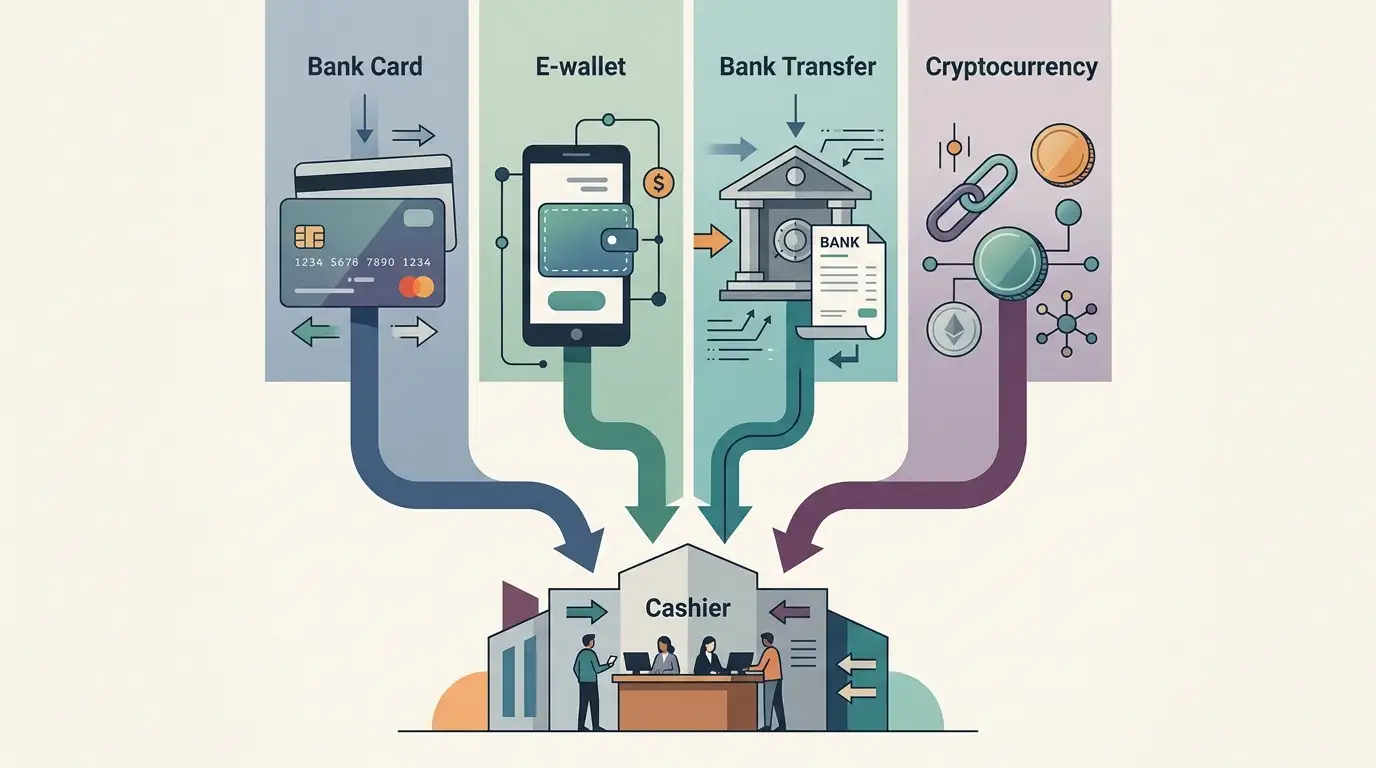
The word “direct” can also create an impression that money passes from one account to another without an intermediary. That should not be assumed from the name. A payment provider may be involved in presenting a bank-linked option, and the steps may differ between cashiers. The relevant distinction is whether the transaction is described as a bank transfer, initiated through an Open Banking service, or processed through another named payment method. The exact route can be identified from the cashier’s instructions and transaction confirmation.
Nor does a shared bank-account connection make all casino payment options equivalent. A card payment is still a card transaction; a wallet payment remains a wallet transaction; and an Open Banking payment should not automatically be described as a manual transfer. Such distinctions are useful when interpreting cashier labels and payment records. They also prevent an assumption that one route’s characteristics necessarily apply to another.
In the UK, credit-card payments for gambling are prohibited at UK-licensed casinos. That restriction should not be confused with the use of a debit card or an account-based payment route. The relevant question is the actual payment product and route being used, rather than whether a payment appears in a bank account statement. Payment labels do not override the rules that apply to the underlying transaction.
- Check the cashier for specific payment names
- Read the instructions for each distinct route
- Verify the payment product type
- Assume “direct banking” is a single standard method
- Treat Open Banking as a synonym for all bank payments
- Rely on broad category labels alone
“Casino with Open Banking” can consequently mean different things in different contexts. It may describe a site whose cashier offers an Open Banking option, but it does not establish that every bank is supported, that every customer can use it, or that the same option is available for every type of transaction. A cashier’s list may change, and the available choices need not be identical across operators. A general description of a casino’s payment methods is not a substitute for the options presented within that casino’s own account interface.
The term is most useful when treated as an initial category, not a precise specification. To understand what a casino means by direct banking, the payment option has to be named and its instructions read as a distinct route. That keeps bank transfers separate from Open Banking initiation, card payments, e-wallets and prepaid methods, without implying that every cashier uses the same terminology or offers the same set of choices.
Instant Deposits, Withdrawals and Bonus Conditions
A quick deposit and a quick withdrawal are separate outcomes. A casino payment route may move money into a playing account promptly without ensuring that a later payout will be sent or received at the same speed. The distinction matters when assessing claims about instant banking: the word “instant” may describe the deposit step alone, rather than the complete movement of funds in both directions.
Some specialist casino reviews describe open banking and bank transfers as capable of supporting instant deposits and fast withdrawals at many sites. That is a reported possibility, not a guarantee for every casino or transaction. The description does not establish how quickly a particular operator will approve a payout, nor whether the bank will complete the transfer immediately. For a casino that accepts direct-banking deposits, the deposit and withdrawal arrangements therefore need to be understood separately.

A specialist review also reports that a card deposit can be instant even when the associated payout takes several business days. This illustrates why a fast funding experience should not be treated as evidence of equally fast access to winnings. The direction of payment changes the process: a deposit credits the casino account, while a withdrawal involves the casino sending funds out. The two steps may have different handling times.
Open banking searches often combine questions about instant deposits with questions about an “instant withdrawal”. Those are not interchangeable claims. An instant deposit refers to money reaching the casino account; a withdrawal claim concerns money leaving it and becoming available through the receiving route. A payment method described as fast can still be subject to the casino’s own processing, so a method label alone does not establish the timing of a completed payout.
Bonus eligibility is a further, independent question. A payment route may work for deposits while being excluded from a promotion, or its use may affect whether a bonus can be claimed. A specialist review notes that PayPal may be excluded from bonus eligibility despite its reputation for speed and convenience. This is a source-specific observation, not evidence that the same condition applies to every casino or promotion.
The same distinction applies to searches for an open-banking casino with a no-deposit bonus or free spins. The fact that open banking is available as a deposit route does not establish that a casino offers either promotion, or that the method qualifies for it. Availability of a payment method and the terms of a promotion are separate conditions. A headline referring to free spins or a no-deposit offer cannot, by itself, show that a direct-banking deposit is eligible.
Deposit speed, payout handling, and bonus eligibility are independent factors; a rapid deposit does not guarantee a fast withdrawal or promotional eligibility.
For a deposit bonus, the relevant terms are those attached to the specific promotion and cashier transaction. They determine whether the selected route qualifies; the payment method’s speed does not answer that question. Where a bonus is not being claimed, the promotion conditions need not be assumed to affect the payment’s processing. Conversely, where a bonus is involved, a successful deposit does not prove that the promotional credit will apply.
The practical comparison is therefore not simply “instant” versus “slow”. Deposit speed, payout handling and bonus eligibility describe different parts of the transaction. A casino may support a rapid deposit but process withdrawals on a separate timetable, while promotional rules may treat the chosen method differently from the payment route itself. These distinctions help prevent a claim about one stage from being read as a promise about the others.
Assessing Casino Payment Options Without a Site Ranking
A useful comparison of direct-banking casino sites starts with the payment route, not a claim that one operator is “best”. A method’s presence on a general payments page does not establish that it is available to every UK customer, nor that it works for both funding and cashing out. The relevant question is whether the same route is supported for the transaction being assessed.

Deposit and withdrawal compatibility should therefore be recorded separately. A cashier may offer a route for deposits without making it available for withdrawals; that distinction affects whether the method can serve as a complete payment option. Any comparison that treats a deposit button as proof of two-way support risks overstating what the casino provides.
The evidence should also be current and specific to the UK. A specialist payment-method review lists Visa and Mastercard among methods shown by the sites it examines, but that does not establish current UK availability or eligibility for every card product. Those details require confirmation in the casino’s cashier. A method named on an older review or general information page is not, by itself, evidence of present access.
Compare the whole cost
Fees are another comparison criterion, but there is no single method that can be identified as the cheapest in every case. A specialist payment-method review notes that the total can include a casino charge, a provider fee, a bank or card issuer fee, a currency-conversion spread, or a network cost. Which of these applies depends on the route and transaction.
A visible fixed charge is not necessarily the only relevant cost. Currency conversion can involve a spread, so comparing payment methods requires looking at the exchange rate as well as any stated fee. The meaningful comparison is the total cost for the intended transaction, rather than an isolated headline charge. If a fee or exchange rate is not displayed clearly, the comparison should mark that point as unresolved rather than infer a cost.
Attention: Total transaction costs may include casino charges, provider fees, bank issuer fees, and currency-conversion spreads.
Separate payment access from promotions
A casino’s payment options and its promotional terms are separate matters. A route that accepts a deposit does not, on that basis alone, establish eligibility for a welcome offer or a no-deposit promotion. Such offers have their own conditions, and a payment-method comparison should not imply that a direct-banking deposit unlocks a bonus. Where promotional eligibility matters, it needs to be assessed from the applicable terms rather than inferred from the cashier.
This distinction is especially important when a page groups payment claims and bonus language together. The existence of a payment route is evidence about transaction access; it is not evidence about the terms of a promotion. A comparison that keeps those questions separate is less likely to turn a narrow payment fact into a broader claim about value.
A sound assessment consequently records what is confirmed, what remains conditional, and whether the route supports both sides of the transaction. It avoids ranking casinos on the strength of a payment logo or an unqualified “accepted” label. The result is not a universal verdict on the best direct-banking casino, but a clearer basis for comparing the actual payment service available at each site.
What to Check When a Casino Says It Accepts Direct Banking
When choosing a casino that accepts direct banking, payout processing is one practical detail to consider. This list gives a quick reference to the payout speed stated for each operator.
Payout speed: 1-3 business days Jetsetspins lists a payout speed of 1–3 business days.
Payout speed: 1-3 business days WinBeast lists a payout speed of 1–3 business days.
Payout speed: 1-3 business days NightLuck lists a payout speed of 1–3 business days.
Payout speed: 1-3 business days x3bet lists a payout speed of 1–3 business days.
Payout speed: 1-3 business days Zombillion lists a payout speed of 1–3 business days.
Payout speed: 1-3 business days BeOnBet lists a payout speed of 1–3 business days.
Payout speed: 1-3 business days SlotoSport lists a payout speed of 1–3 business days.
Payout speed: 1-3 business days Chanze lists a payout speed of 1–3 business days.
Payout speed: 1-3 business days SpinFormula lists a payout speed of 1–3 business days.
Payout speed: 1-3 business days EvoSpin lists a payout speed of 1–3 business days.
An acceptance claim is only useful when it matches the payment options available for the specific account and transaction. A casino may describe direct banking or Open Banking on an information page, but the cashier is the practical place to confirm whether the route is currently offered. Availability can depend on the operator’s payment arrangements and the customer’s circumstances, so a general label should not be treated as confirmation that every account can use it.
The cashier should also be checked for the direction of payment. A method shown for deposits is not automatically available for withdrawals. Where direct banking is listed, the accompanying instructions should make clear whether it applies to funding, payouts, or both. If the cashier does not distinguish these functions, the payment information or operator support can clarify the position before a transaction is started.
The same verification matters for familiar card options. Visa and Mastercard may appear in casino payment information, but that does not establish that every card product is eligible or currently usable in the UK cashier. UK-licensed casinos cannot accept credit-card payments for gambling. A card logo is therefore not sufficient evidence that a particular card can be used: the product type and the option presented during the transaction need to be consistent with the applicable restriction.

Account currency is another point to settle before making a payment. Casino information may refer to GBP support, but the currency selected for an individual account is what matters for avoiding conversion. If the account is held in a different currency from the payment account, an exchange may be applied during the transaction. The cashier and account settings should therefore be reviewed before the first deposit, rather than assuming that a UK-facing site has set every account to pounds sterling.
A payment screen can also distinguish between a method being named in general terms and a particular provider being available. “Direct banking” may be used as a broad description, while the cashier presents a specific bank-payment service or a list of participating banks. The precise option shown is more informative than the broad wording alone. If the service is not available at that point, a general statement elsewhere on the site does not establish that the transaction can proceed through it.
These checks concern whether the advertised route is usable for the intended account and payment, not whether a casino’s general payment list is comprehensive. The relevant evidence is the current cashier display, the stated account currency, and clear instructions about the transaction’s purpose. This avoids treating a method name as a guarantee of availability or assuming that deposit and withdrawal functions are interchangeable.
Direct Banking in the UK: Limits, Currency and Financial Controls
Deposit limits are shaped by more than the payment route. A direct banking option may have its own minimum or maximum, while the casino can apply separate account-level restrictions. The amount available for a deposit can therefore depend on both the selected method and the customer’s account status; a figure shown for one route should not be assumed to apply to every route at the same casino.
A specialist review reports that minimum deposits may fall within the £10–£20 range, depending on the payment method. That is an indicative range, not a universal threshold for UK direct banking casinos. The amount displayed in the cashier is the relevant one for a particular transaction, since payment options and their terms can differ between casino sites.
Maximum deposits can be set per transaction, per day or per month. The applicable ceiling may vary with the payment method and account status, so a bank-linked payment does not imply that an account can be funded without restriction. These limits also need to be distinguished from personal financial controls: a cashier cap restricts what can be deposited through a route or account, while a customer-set limit is a tool for controlling gambling expenditure.

UK Gambling Commission rules require remote gambling licensees to prompt new customers to set a financial limit before they make their first deposit. They must also provide accessible account-level limit controls. This means the first-deposit process at a UK-licensed casino includes a financial-control step, rather than treating the payment screen as the only point at which funding is governed.
The controls can matter even where a chosen direct banking casino accepts the requested payment method. Payment availability does not remove the requirement to set a limit, nor does it establish that the casino’s own deposit cap matches the selected personal limit. The cashier and account settings serve different purposes, and both may affect how much can be deposited.
Currency is another part of the funding conditions. Casino account pages may support GBP, but the account currency should be confirmed before the first transaction. If the account and bank payment use different currencies, conversion may affect the amount credited. A deposit limit stated in one currency should not be treated as a guaranteed equivalent in another.
For a UK direct banking casino, the practical position is therefore determined by several controls: the payment method’s minimum and maximum, any casino-level cap, the customer’s account status, the selected account currency and the personal limit set within the account. Published terms can describe these conditions, but the cashier and account controls determine which options apply at the point of deposit.
Payment Routes for Deposits and Withdrawals
Casino cashiers can present several kinds of payment route side by side, but their appearance in the same menu does not mean they work in the same way. A specialist review of casino payment pages recorded Visa, Mastercard, bank transfer, e-wallets and several cryptocurrencies among the methods mentioned. That is evidence of the range displayed on the sites it examined, not a universal list for every UK casino.
Includes bank transfers and Open Banking services used for funding and payouts.
Commonly involves Visa and Mastercard debit cards accepted by UK casinos.
Separate routes such as wallets or deposit-only prepaid vouchers like Paysafecard.
Open Banking and bank transfer are relevant to direct banking, but a payment route’s role should be established separately for deposits and withdrawals. A cashier may show a method for adding funds without confirming that winnings can be paid through it. Conversely, a withdrawal route may be available only after a particular funding method has been used or after further checks. The method names alone do not establish either capability.
This distinction also applies to familiar alternatives. Visa and Mastercard are card brands, while e-wallets and cryptocurrency are different payment categories; their presence in a cashier does not imply identical terms or compatibility. A listed option should therefore be treated as available for a particular transaction only when the cashier identifies it for that purpose. Deposit availability should not be read as proof of withdrawal availability.
The payment route can also affect where a payout is sent. UK anti-money-laundering requirements generally direct casino winnings back to the original payment source. Returning funds to that source is also a common anti-fraud measure. Where the original route cannot receive a payout, an alternative may be considered, but it can bring additional verification. This is a reason to distinguish a method used to fund an account from the route that can receive funds later.

Accordingly, a comparison of payment routes needs two separate checks: whether a method is offered for deposits, and whether it is accepted for withdrawals under the account’s circumstances. Open Banking may be presented as an instant banking option, but that label alone does not establish that every casino supports both directions. The cashier’s transaction-specific options, together with the operator’s payment terms, are the relevant evidence. A route should not be described as a withdrawal method solely because it appears among deposit choices.
Why Direct-Banking Withdrawals May Not Be Instant
A bank-linked payment route does not determine the full time taken for a casino withdrawal. The payout can involve separate stages: the casino reviews the request, any required account checks are completed, and the bank-transfer service delivers the funds. A fast transfer at the final stage cannot remove time spent earlier in the process.
Specialist reviews describe Open Banking and bank transfers as capable of supporting fast withdrawals at many sites. That is a report about possible performance, not a guarantee that every direct-banking casino withdrawal will be instant. The casino’s own approval process and the account’s verification status also affect when a payout is released. An account that has not completed verification may need additional checks before the casino approves a first withdrawal.
This distinction matters when assessing claims about an instant banking withdrawal. “Instant” may describe the payment route under particular conditions, rather than the interval from submitting a withdrawal request to receiving cleared funds. If the casino has not approved the request, the bank-transfer stage may not yet have begun. The payment method’s advertised speed therefore cannot, by itself, establish the complete payout time.
Factors Affecting Delivery Speed
Payout timing can be influenced by bank-transfer cut-off times, weekends, and the need for currency conversion.
Delivery can also be affected by the bank-transfer timetable. Specialist reviews identify cut-off times, weekends and currency conversion as factors that may alter when a transfer arrives. A request processed outside a relevant cut-off, or one that involves converting currency, may not follow the same path as a straightforward transfer. The precise effect depends on the casino’s process and the banks or payment services involved.
For a UK casino withdrawal, the useful distinction is between processing and delivery. Processing covers the casino’s review and approval; delivery covers the movement of funds after release. These stages should not be treated as interchangeable when a site describes its direct-banking option as fast. The stated timeframe and conditions in the cashier are more informative than the payment label alone, particularly where verification is incomplete or the account currency differs from the transfer currency. A route may be capable of rapid payment while a particular withdrawal still takes longer because approval or delivery conditions intervene.

Direct Banking and GamStop Status Are Separate Questions
A casino’s payment options and its GamStop status describe different things. A cashier may display direct banking or an instant banking service, but that information does not establish whether the operator participates in GamStop. The same applies in reverse: a statement about self-exclusion does not confirm which banking methods are available.
This distinction matters when a site is described as a “direct banking casino not on GamStop”. The payment label alone cannot support that description. Payment availability concerns how funds may be moved; GamStop status concerns self-exclusion. Each claim needs to be assessed separately, rather than treating access to a banking route as evidence about a casino’s regulatory position.
In Great Britain, remote gambling licensees must provide self-exclusion tools, and online gambling is legal only through operators holding the relevant UK Gambling Commission licence. A payment method does not override those requirements or demonstrate that an operator is licensed. Nor does a reference to “non-GamStop” establish that a site is suitable or lawful for UK customers.

Self-exclusion is relevant to more than the wording on a casino’s website. It is an account-level protection intended to prevent gambling with participating operators. Where self-exclusion is in place, looking for a different payment route does not change that status or remove the need to consider the protection.
The practical distinction is therefore clear: direct banking describes a possible way to fund an account, while GamStop relates to self-exclusion. Neither should be used as a proxy for the other, and payment access by itself says nothing about an operator’s licence or self-exclusion arrangements.
Keeping Casino Payments Traceable and Consistent
A payment route linked to the same person as the casino account can make the transaction easier to reconcile. Matching account information and payment ownership reduces the chance that basic identity details create avoidable friction. This is a practical consideration for casino direct banking as well as for other payment methods: the relevant point is whether the account holder and the source of funds can be associated consistently.

A straightforward arrangement is often to use one named account for both deposits and withdrawals. Moving between accounts or using a payment route held by someone else can complicate the ownership picture. That does not establish that a transaction will be rejected, but it may lead to questions or additional checks before funds are released.
Closed-loop rules also shape how payouts are handled. UK anti-money laundering requirements commonly mean that funds are returned to the original payment source. Returning money to that source is also a fraud-prevention control. If the original route cannot be used, an alternative may involve further verification rather than an automatic transfer to another account.
For a direct banking casino, the payment method shown in the cashier is therefore only part of the relevant information. The account holder’s details and the route used to fund the casino account matter to the subsequent payment trail. Consistency can reduce avoidable ownership queries, but it does not remove the casino’s checks or determine how quickly a withdrawal is processed. A clear record of the account and payment route helps explain where funds came from and where they are expected to return.
Why must withdrawals return to the deposit method?
Returning funds to the original payment source is a common anti-fraud and anti-money-laundering control. Using a payment method in the same customer’s name can also reduce avoidable verification issues.
What is the fastest withdrawal method for UK casinos?
PayPal, Open Banking services and debit cards linked to fast payout systems are generally among the quickest options. The actual time also depends on the casino’s approval process and whether your account is verified.
Are fast casino withdrawals guaranteed?
No. Withdrawal speed can be affected by the casino’s approval process and account verification, and a card deposit that is instant can still have a payout that takes several business days.
Can I deposit in GBP?
Yes, GBP is supported. Confirm that your account is set to GBP before your first transaction to avoid currency conversion.
What is the current minimum deposit?
The minimum deposit usually starts at £10–£20, depending on the payment method.
Which payment methods are accepted in Great Britain?
Commonly listed options include Visa and Mastercard, bank transfers, e-wallets and, at some sites, cryptocurrencies. Availability varies by casino; check its cashier for the methods currently offered.
Are Visa and Mastercard deposits definitely debit cards?
No—not every Visa or Mastercard product is necessarily eligible. UK-licensed casinos cannot accept credit cards for gambling, while debit cards are commonly accepted; check the cashier for current card eligibility.
Created by the ”fam bet Casino” editorial team.